
Supplementary guidance on benefit illustrations
Contents
This guidance supports industry understanding on the use of benefit illustration objects, estimated retirement income (ERI) and accrued components, and illustration dates, to return value data in view responses. It supplements the data standards. We intend to incorporate elements of this guidance into the data standards, becoming part of the compulsory framework, at the next available opportunity.
Where values are unavailable, an appropriate ‘unavailable’ code (data standards 2.301/401) should be returned to explain the absence
ERI/accrued unavailable codes explain the absence of the values. An unavailable code (such as ‘DBC’/’DCC’ where values are being calculated) should always be returned where values cannot be returned. This should be done instead of simply not returning a benefit illustration, or not returning an ERI or accrued component within an illustration. See data standards paragraph 47:
Return the first field of each section (2.301 or 2.401) if the ERI or accrued values cannot be sent in this return.
Pension providers and schemes determine which unavailable code to return.
ERI or accrued value unavailable codes are returned within a benefit illustration object in the view JSON schema. The illustration object contains the ERI and accrued components, each of which allows the unavailable codes to be returned instead of values. Therefore, if either the ERI or accrued values are not available to return, an ERI/accrued component should still be returned as part of the benefit illustration object, containing one of the ‘unavailable’ codes.
For example, for a deferred defined benefit pension, for which only accrued values are to be returned, the benefit illustration should contain 2 components:
- 1 accrued component (containing the payable details)
- an ERI component (containing the ERI unavailable field 2.301 populated with the code ‘DB’).
There should therefore always be at least one benefit illustration object provided in a view response for a definite match.
The only exceptions are where ‘contact scheme’ (data standard 2.004) or ‘temporary system error’ (2.006) are populated ‘true’. In these cases, there may be no benefit illustration objects (because 2.004/6 are returned outside of benefit illustration objects, as objects themselves in the definite match arrangement). These codes enable pension providers and schemes to explain absence of information to users, but their use does not absolve the pension provider/scheme of its legal duties in respect of provision of information.
Where 2.004 and 2.006 do not apply, even where values are not available, a benefit illustration with ERI and accrued components, containing the appropriate unavailable code to explain the absence of the values, should be populated.
Returning a value unavailable code does not prevent values being returned in another illustration component. For example, if the ERI component contains the unavailable code, the accrued component can still contain values, or values could be provided in a separate benefit illustration (for example, values are returned for a separately-accrued lump sum but not for a recurring income).
Back to topUnavailable code for delayed calculations
If a calculation exceeds the timeframe permitted by the legislation, there is currently no code for data standards 2.301/401 to indicate that the time has expired but the calculation is still being worked on and will be provided late. In this scenario, pension providers and schemes should continue to apply ‘DCC’/’DBC’, unless another code is more appropriate.
We may introduce a new code in the next data standards update that explains that there has been a delay. Calculation times are reported under reporting standard 3.2, so regulators will have visibility where prescribed calculation times are exceeded.
Back to topThe value data illustration date (data standard 2.501) is returned for the benefit illustration, not an ERI/accrued sub-component
The legislation requires the illustration date to be provided alongside the value data. The view JSON schema is structured such that this is returned at the level of the benefit illustration object, not the level of the ERI/accrued component within an illustration. Hence, the illustration date applies across both the ERI and accrued components within that benefit illustration (even where values are returned in one component but not another).
See data standards paragraphs:
45. Each separate benefit illustration provided for a pension arrangement is accompanied by an illustration date.
46. ERI and accrued data must have the same illustration date (in the view JSON schema, both ERI and accrued values are set as components within the same benefit illustration object, with a single illustration date).
This is illustrated in the view data model, where 3 items are grouped underneath a benefit illustration:
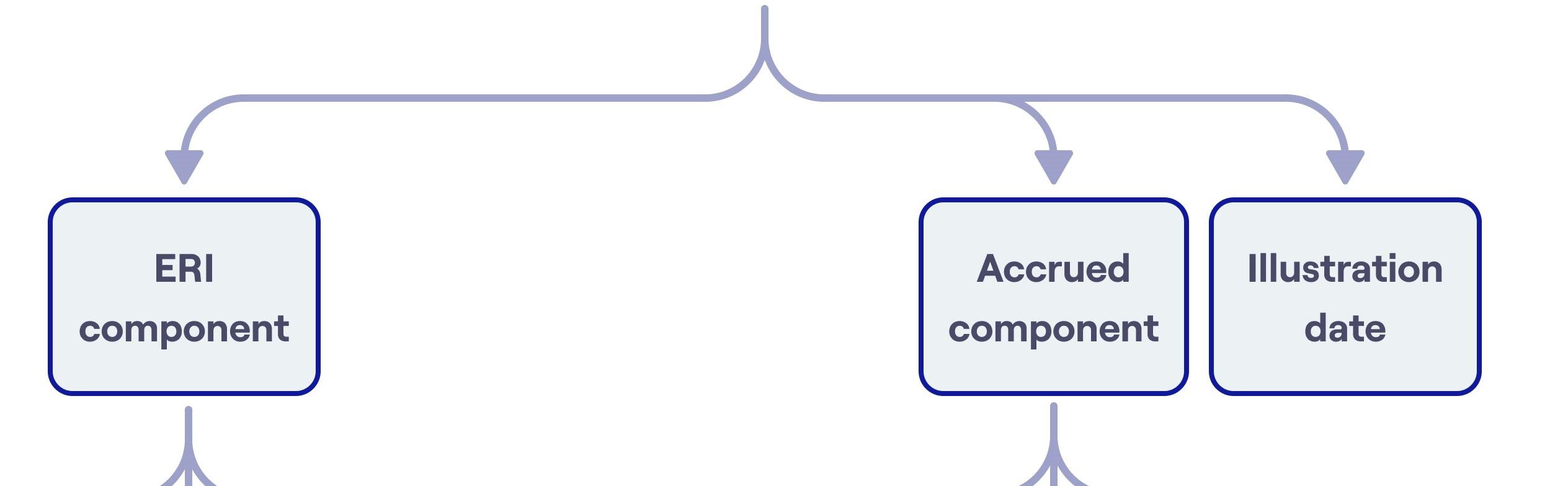
Each benefit illustration should therefore include an illustration date applying to both the ERI and accrued components. For example, in the case of a deferred defined benefit (DB) pension for which only accrued values are returned, the benefit illustration should still contain the illustration date. This applies even though the ERI component is only populated with the ERI unavailable code ‘DB’ for data standard 2.301, because the illustration date applies to the benefit illustration. The only exception where illustration date need not be returned for a benefit illustration would be where both the ERI and accrued components are populated with unavailable codes only – where, given the absence of any values, no illustration date applies.
Although in practical terms an illustration date is returned for each benefit illustration, the legislation nonetheless requires that all value data for a given scheme have the same illustration date. For occupational schemes, TPR’s guidance examines this and illustrates how different illustration dates could be a ‘green’ rated breach.
Back to topMultiple benefit illustrations should be used to return distinct benefits, not to return ERI and accrued components relating to the same benefit separately
The data standards support multiple benefit illustrations. The view JSON schema structures these as an array of benefit illustrations, each with an ERI and an accrued component, plus the illustration date – see diagram above. Multiple benefit illustration objects may be used to facilitate return of value data where the user has distinct benefits under the scheme. ‘Distinct benefits’ refers to there being distinct payment terms, for example, relating to type of benefit or period of payment, or distinct periods of accrual. See also PASA’s value data guidance, which covers benefits payable at different dates, step-ups and step-downs, multiple separate benefits in the same scheme, and additional voluntary contributions (AVCs).
A difference in benefit type (data standards 2.302/402), amount type (2.303/403) and payable dates (2.305/405) would all distinguish different benefits under the scheme, as might periods of membership. Scheme rules and existing communications to members may determine when benefits are to be split into distinct benefit illustrations.
Examples of separate benefits under the scheme to be returned as distinct benefit illustration objects include:
- a separately-accrued lump sum, and a recurring income
- different tranches of income, paid at different levels, paying and possibly ceasing on different dates
- a defined benefit pension and an AVC (where the AVC data is supplied by the main scheme rather than a separately connecting AVC provider)
For each of the member’s benefits under the scheme, the accrued value and the projected value form a twin pair, illustrating its current value and projected value. Each should therefore be returned within a distinct benefit illustration object, which groups together the ERI values, accrued values and illustration date, for each benefit.
Each benefit illustration object should contain both an ERI and an accrued component and a common illustration date.
See data standards paragraph 41:
A pension arrangement may have multiple illustrations. For example, this could be where benefits of different types are payable (an arrangement could have a DB part and a DC part) and/or where benefits are payable on different dates (such as a benefit with multiple tranches of benefit payable from different retirement dates). Multiple ERI or accrued values can then be returned. The view JSON schema therefore sets benefit illustrations as an array. Each distinct benefit illustration provided should be sent as a separate benefit illustration object.
For example, in a case where there is a separately-accrued lump sum and recurring income, 2 benefit illustration objects would be returned:
- one for the separately-accrued lump sum, with an accrued value, a projected value for this lump sum, and illustration date
- one for the recurring income, with the accrued value, ERI, and illustration date
Since distinct benefits should be returned as distinct benefit illustration objects, each benefit illustration object should usually only contain one ERI and one accrued component, not multiples of both. As per data standards paragraph 41:
there should be no more than 2 illustration components (an ERI component and an accrued component) within any given benefit illustration object, except where certain public service schemes are sending two sets of data for each ERI illustration
Multiple benefit illustration objects should not be used to return ERI and accrued values separately for the same benefit.
For example, when returning ERI and accrued values for the same benefit, you should not send 2 benefit illustrations with the first containing only an ERI component and the second containing only an accrued component).
Where values are returned for a single benefit, such as a single recurring income for life only, a single benefit illustration object should be provided, containing both the ERI component, accrued component, and illustration date relating to that benefit.
Back to topClarification to data standards paragraph 42
The data standards paragraph 42 states:
For complex benefit structures, up to 10 ERI illustrations and 10 accrued illustrations may be returned. Therefore, the multiplicity is shown as 10.
At the next available point when we update the data standards, we intend to change this paragraph as follows:
For complex benefit structures, multiple benefit illustrations may be returned. It is intended that no more than 10 benefit illustrations should be used, each containing an ERI and accrued component (and an illustration date). Therefore, the multiplicity for the ERI and accrued data fields is shown as 10 – one of each of an ERI and an accrued component for each of the up to 10 benefit illustrations.
Examples with JSON downloads
These examples assume a single data provider is returning the data, and do not cover cases where multiple parties return data for the same scheme. Those involving multiple benefit illustration objects also assume the pension provider or scheme has determined that the values returned to dashboards should be split into multiple benefits. The examples then illustrate how the benefit illustrations should be structured.
You can download JSON files that demonstrate each example.
Download benefit illustration JSON examples
This zip folder contains:
- example-1_complete.json – for DC pension, values available
- example-2_complete.json – for Active DB pension with a recurring income and a separately-accrued lump sum, values available
- example-3_complete.json – for Deferred DB pension, recurring income only, (accrued) values available
- example-4_complete.json – for Deferred DB pension with 2 payment tranches, values available
- example-5_complete.json – for Active hybrid scheme benefits – a DC benefit and a DB benefit (comprised of 2 tranches), values available
- example-6_complete.json – for Deferred DB pension with 2 payment tranches, values unavailable – being calculated
- example-7_complete.json – for Deferred DB pension with 2 payment tranches, values available for one tranche but not the other (being calculated)
- example-8_complete.json – for McCloud Remedy public service pension with income and lump sum values on both legacy and new bases
1. DC pension, values available
Should be structured as one benefit illustration object, containing:
- one accrued component, with ‘payable details’ returned as recurring income details and values populated
- one ERI component, with ‘payable details’ returned as recurring income details and values populated
- one illustration date for this benefit
2. Active DB pension with a recurring income and a separately-accrued lump sum, values available
Should be structured as 2 benefit illustration objects.
One for the recurring income containing:
- one accrued component, with ‘payable details’ returned as recurring income details and values populated
- one ERI component, with ‘payable details’ returned as recurring income details and values populated
- one illustration date for this benefit
Another for the lump sum containing:
- one accrued component, with ‘payable details’ returned as lump sum details and values populated
- one ERI component, with ‘payable details’ returned as lump sum details and values populated
- one illustration date for this benefit
3. Deferred DB pension, recurring income only, (accrued) values available
Should be structured as one benefit illustration object, containing:
- one accrued component, with ‘payable details’ returned as recurring income details and values populated
- one ERI component, returned as unavailable code ‘DB’ (2.301)
- one illustration date for this benefit
4. Deferred DB pension with 2 payment tranches, values available
Should be structured as 2 benefit illustration objects.
One benefit illustration for the first tranche containing:
- one accrued component, with ‘payable details’ returned as recurring income details and values populated, with the accrued payable date (2.405) and accrued end date (2.409) used to identify the beginning and end (where relevant) of this first tranche
- one ERI component, returned as unavailable code ‘DB’ (2.301)
- one illustration date for this benefit
One benefit illustration for the second tranche, containing:
- one accrued component, with ‘payable details’ returned as recurring income details and values populated, with the accrued payable date (2.405) and accrued end date (2.409) (where relevant) used to identify the second tranche
- one ERI component, returned as unavailable code ‘DB’ (2.301)
- one illustration date for this benefit
5. Active hybrid scheme benefits – a DC benefit and a DB benefit (comprised of 2 tranches), values available
Should be structured as 3 benefit illustration objects.
One for the DC benefit, containing:
- one accrued component, with ‘payable details’ returned as recurring income details and values populated, and accrued benefit type returned as ‘DC’
- one ERI component, with ‘payable details’ returned as recurring income details and values populated, and accrued benefit type returned as ‘DC’
- one illustration date for this benefit
Another for the first tranche of DB benefit, containing:
- one accrued component, with ‘payable details’ returned as recurring income details and values populated, and accrued benefit type (2.402) returned as ‘DB’, with the accrued payable date (2.405) and accrued end date (2.409) (where applicable) used to identify the beginning and end of this first tranche
- one ERI component, with ‘payable details’ returned as recurring income details and values populated, and ERI benefit type (2.302) returned as ‘DB’, with the ERI payable date (2.305) and ERI end date (2.309) (where relevant) used to identify this first tranche
- one illustration date for this benefit
Another for the second tranche of DB benefit, containing:
- one accrued component, with ‘payable details’ returned as recurring income details and values populated, and accrued benefit type (2.402) returned as ‘DB’, with the accrued payable date (2.405) and accrued end date (2.409) (where relevant) used to identify the beginning and end of this second tranche
- one ERI component, with ‘payable details’ returned as recurring income details and values populated, and ERI benefit type (2.302) returned as ‘DB’, with the ERI payable date (2.305) and ERI end date (2.309) (where relevant) used to identify this second tranche
- one illustration date for this benefit
6. Deferred DB pension with 2 payment tranches, values unavailable – being calculated
Should be structured as 2 benefit illustration objects.
1 benefit illustration for the first tranche containing:
- one accrued component, returned as unavailable code ‘DBC’ (2.401)
- one ERI component, returned as unavailable code ‘DB’ (2.301)
Another for the second tranche, containing:
- one accrued component, returned as unavailable code ‘DBC’ (2.401)
- one ERI component, returned as unavailable code ‘DB’ (2.301)
7. Deferred DB pension with 2 payment tranches, values available for one tranche but not the other (being calculated)
Should be structured as 2 benefit illustration objects.
One benefit illustration for the first tranche containing:
- one accrued component, with ‘payable details returned as recurring income details and values populated, with the accrued payable date (2.405) and accrued end date (2.409) (where relevant) used to identify the beginning and end of this tranche
- one ERI component, returned as unavailable code ‘DB’ (2.301)
- one illustration date for this benefit
Another for the second tranche, containing:
- one accrued component, returned as unavailable code ‘DBC’ (2.401)
- one ERI component, returned as unavailable code ‘DB’ (2.301)
8. McCloud Remedy public service pension with income and lump sum values on both legacy and new bases
Should be structured as 4 benefit illustration objects.
One benefit illustration for the legacy basis income value containing:
- one accrued component, with payable details returned as recurring income details and values populated, with amount type 'INCL'
- one ERI component, with payable details returned as recurring income details and values populated, with amount type 'INCL'
- one illustration date for this benefit
One benefit illustration for the legacy basis lump sum value containing:
- one accrued component, with payable details returned as lump sum details and values populated, with amount type 'CSHL'
- one ERI component, with payable details returned as lump sum details and values populated, with amount type 'CSHL'
- one illustration date for this benefit
One benefit illustration for the new basis income value containing:
- one accrued component, with payable details returned as recurring income details and values populated, with amount type 'INCN'
- one ERI component, with payable details returned as recurring income details and values populated, with amount type 'INCN'
- one illustration date for this benefit
One benefit illustration for the legacy basis lump sum value containing:
- one accrued component, with payable details returned as lump sum details and values populated, with amount type 'CSHN'
- one ERI component, with payable details returned as lump sum details and values populated, with amount type 'CSHN'
- one illustration date for this benefit
Support
If you are experiencing issues with the connection portal or have questions about the provided guidance, our support hub is here to help. You can visit PDP’s support hub to get assistance, raise new queries, or report incidents.
Changelog
Last updated:03/09/2026
3 September 2026
3 September 2026
- Additional example added: McCloud Remedy public service pension with income and lump sum values on both legacy and new bases.
15 June 2026
15 June 2026
- Updated 'Examples with JSON downloads' section with corrected JSON files.
2 April 2026
2 April 2026
- Added downloadable JSON file examples for benefit illustrations.